For twenty-five years, Google’s business model has been simple: you search, Google shows you a page full of links, and advertisers pay for the best spots on that page. But what happens when users stop scrolling through results and simply accept one AI-generated answer? That is the multi-billion-dollar question behind the AI search revolution.
Tools like ChatGPT and Google’s own Gemini give a single, conversational response instead of a page of options. If one answer replaces ten blue links and a stack of paid ads, can Google survive the AI revolution? In this guide, we look at the real numbers from 2024 to 2026, including half-yearly growth rates, ChatGPT’s user growth, and how Google is rebuilding its advertising model.
The Old Model: Why a Google Results Page Is an Ad Goldmine
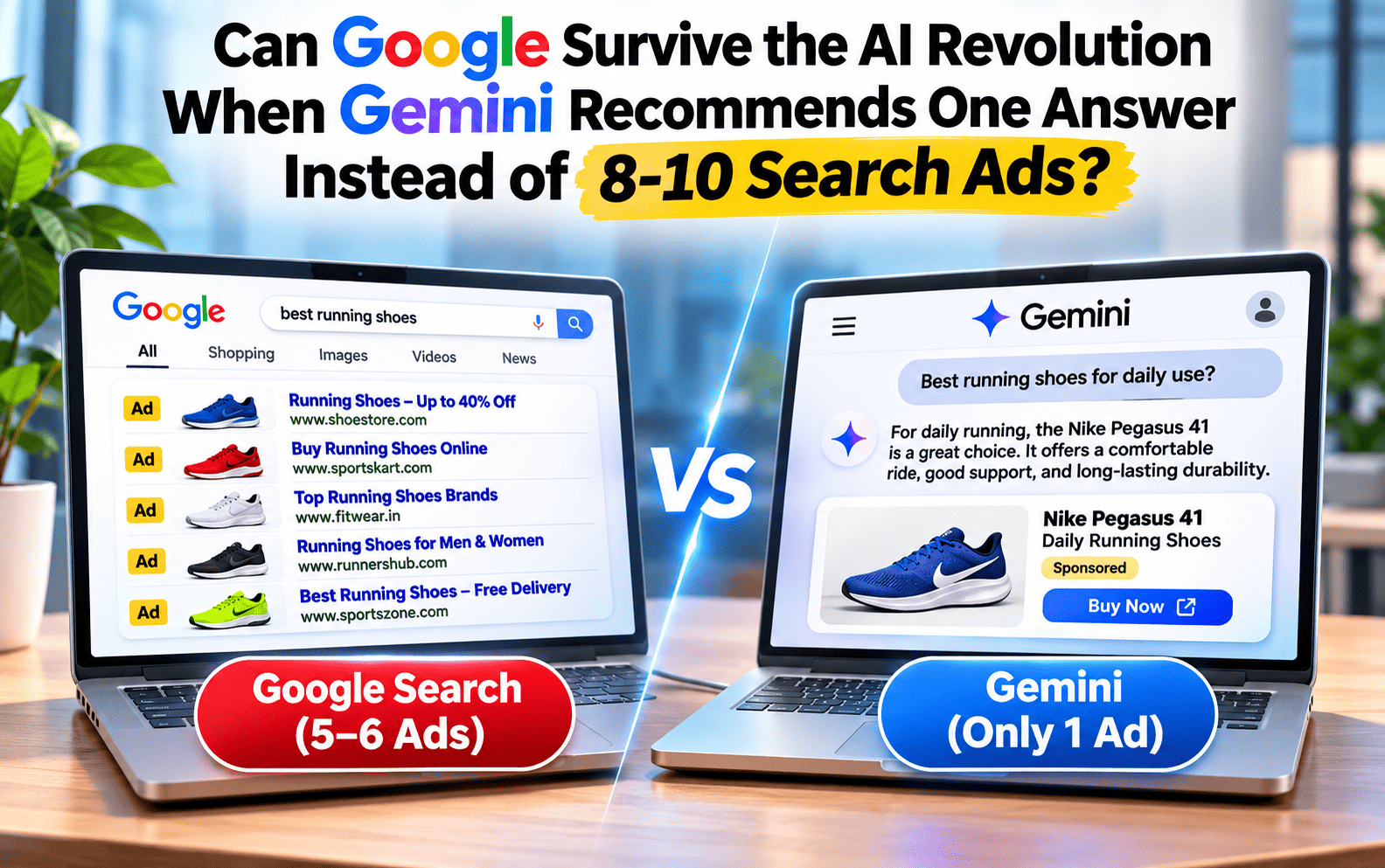
When you search for “best running shoes” or “plumber near me,” Google can show several paid placements at once: text ads at the top, shopping carousels, local business ads, and more at the bottom. Depending on the query, a single results page can carry roughly 8 to 10 commercial placements, each competing in a live auction.
This is why Google’s advertising engine is so powerful. More ad slots mean more competition among advertisers, higher cost-per-click, and more revenue per search. In 2024 alone, Alphabet’s “Google Search & other” segment generated about $198 billion, the largest single profit pool in the company.
The AI Threat: One Answer, Very Few Ad Slots
Now compare that with an AI assistant. When you ask a chatbot for the best running shoes, you get one structured answer, often with a clear recommendation. There is no page of ten competing ads, and there may be room for only one sponsored placement, or none at all.
This is the heart of the “innovator’s dilemma” for Google:
- Fewer ad slots per query means less auction pressure and potentially lower revenue per search.
- Fewer clicks to websites means advertisers may see less value in paying for traffic.
- Higher trust in a single AI answer means users may not scroll to compare options at all.
If this shift happens at full scale, the economics of search advertising change dramatically. That is why investors and marketers are asking whether Google can survive the AI revolution.
Reality Check: How Gemini and AI Mode Actually Show Ads
It is important to be precise here, because this is often misunderstood. As of late 2026, Google’s new ad formats run inside AI Overviews and AI Mode in Google Search, not as a separate ad inventory inside the standalone Gemini app, which was reported to remain ad-free in available industry coverage.
At Google Marketing Live on May 20, 2026, Google announced new Gemini-powered formats such as Conversational Discovery ads and Highlighted Answers. Both are labelled “Sponsored.” Highlighted Answers place a paid item directly inside an AI recommendation list, while Conversational Discovery ads add a Gemini-written sponsored response to a user’s question. These were announced as tests in the United States, bought through existing Google Ads tools such as Performance Max and AI Max.
Third-party tracking in April 2026 estimated that around 25.5% of AI Mode responses showed a sponsored placement. That tells us something important: the AI era does not remove ads, it changes their shape. Instead of eight to ten stacked ads, there are fewer, more targeted, more contextual placements inside the answer itself.
ChatGPT Is Growing Fast, and It Now Sells Ads Too
The pressure on Google is real, because ChatGPT’s growth has been extraordinary. According to figures reported by OpenAI and widely cited by industry trackers:
- February 2025: about 400 million weekly active users
- February 2026: more than 900 million weekly active users (roughly +125% in a year)
- August 2026: OpenAI reported around 1 billion weekly users, with some trackers citing about 1.2 billion by late September 2026
OpenAI has also moved into advertising. ChatGPT ads began testing on February 10, 2026, first for free-tier and Go-plan users in the US, and reports indicate the format places a clearly labelled ad below the AI response. Industry reports put ChatGPT’s ad business at a roughly $1 billion annualized run rate by the end of August 2026, though this is a company-claimed, annualized figure.
The lesson: the “one answer, one ad” model is not just a theory. ChatGPT is running it today, and it is the closest thing to a direct replacement for search ads.
Google’s Real Numbers: 2024 to 2026 (Half-Yearly Growth)
Now for the part that surprises most people. Despite the AI panic, Google’s search revenue has grown faster, not slower, during the ChatGPT era. The table below uses Alphabet’s reported quarterly results, combined into six-month periods.
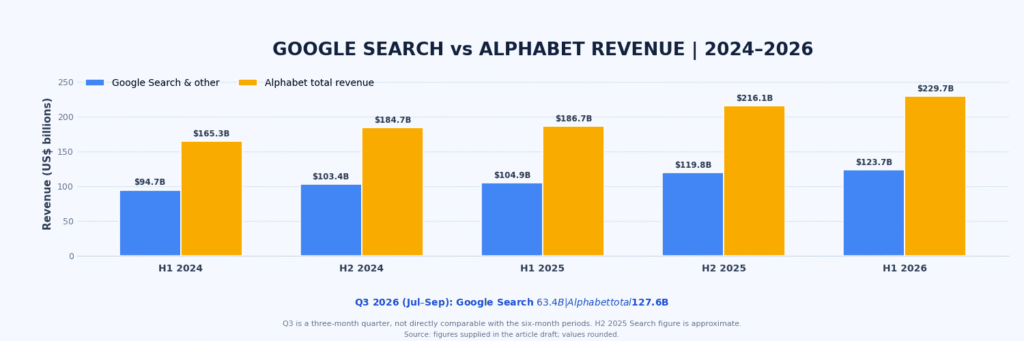
| Period | Google Search & other revenue | Growth vs same period last year | Change vs previous 6 months | Alphabet total revenue | Total revenue YoY growth |
|---|---|---|---|---|---|
| H1 2024 (Jan–Jun) | $94.7B | – | – | $165.3B | – |
| H2 2024 (Jul–Dec) | $103.4B | – | +9.2% | $184.7B | – |
| H1 2025 (Jan–Jun) | $104.9B | +10.8% | +1.4% | $186.7B | +13.0% |
| H2 2025 (Jul–Dec) | about $119.8B | +15.8% | +14.2% | $216.1B | +17.0% |
| H1 2026 (Jan–Jun) | $123.7B | +17.9% | +3.2% | $229.7B | +23.0% |
| Q3 2026 (Jul–Sep, partial) | $63.4B | +12% | – | $127.6B | +25% |
Figures are rounded and calculated from Alphabet’s quarterly earnings releases and SEC filings. The H2 2025 search figure is approximate because it is derived from the reported 17% Q4 2025 growth rate. Always verify against Alphabet’s investor relations page before citing.
What the Numbers Tell Us
1. Full-year growth is strong. Search & other revenue rose from roughly $198 billion in 2024 to about $225 billion in 2025 (around +13%). Alphabet’s total revenue passed $400 billion in 2025 for the first time, up from about $350 billion in 2024.
2. Growth accelerated during the AI boom. Year-over-year search growth climbed from about 11% in H1 2025 to about 16% in H2 2025 and nearly 18% in H1 2026. In Q1 2026, Search & other grew 19%, and Alphabet said queries were at an all-time high.
3. But there is a slowdown signal. In Q3 2026, Search & other grew 12%, down from 17% in Q2 and 19% in Q1. Search revenue of $63.4 billion also came in below the roughly $65 billion analysts expected, and the stock fell in after-hours trading. This is the strongest evidence for the bears, even though Alphabet noted that Search query growth was the highest in five years.
So the honest conclusion is this: AI has not broken Google’s search business yet, but the growth rate is no longer a straight line upward.
Why Google Is Not Dying: Five Reasons
1. Queries Are Going Up, Not Down
If AI chatbots were stealing searches, Google’s query volume would fall. Instead, Alphabet reported record query growth in Q3 2026, and said AI features are driving more commercial queries. AI Overviews and AI Mode appear to be expanding how often people search.
2. Gemini Has Massive Reach
Sundar Pichai said in October 2026 that the Gemini app has reached one billion users, calling it the fastest-growing product in Google’s history. Google does not need to win by blocking ChatGPT; it only needs to keep users inside its own ecosystem.
3. Google Cloud Is a Second Engine
Google Cloud revenue grew 103% to $30.7 billion in Q3 2026, powered by enterprise AI demand. Cloud grew from about $12 billion per quarter in early 2025 to over $30 billion, which means Alphabet’s future no longer depends on search ads alone.
4. Distribution Is Unmatched
Google controls Android, Chrome, YouTube, Gmail and Maps. Billions of people meet Gemini automatically without downloading anything new, which is a huge advantage over a standalone app.
5. Subscriptions Are Growing
Google now reports over 350 million paid subscriptions, driven by YouTube and Google One. Subscriptions reduce the company’s dependence on advertising.
The Real Risks Google Still Faces
Google’s survival is likely, but its dominance is not guaranteed. Here are the genuine threats:
- Lower revenue per query. If one sponsored placement replaces eight to ten, Google must charge much more per ad or lose revenue.
- Zero-click behavior. If users never visit websites, publishers and advertisers lose incentive to participate.
- Rising costs. Alphabet expected 2026 capital expenditure of $180–$190 billion for AI infrastructure and said 2027 would be significantly higher, which pressures profit margins.
- Regulation. Antitrust scrutiny could limit how Google can promote its own AI products.
- User trust. If sponsored content blends too closely into AI answers, users may lose confidence in the results.
What Google Must Do to Survive and Win
To stay on top, Google needs to execute on four fronts:
- Make AI ads genuinely helpful. Sponsored answers must feel like useful recommendations, not disguised promotions.
- Raise the value per ad. With fewer slots, each placement must deliver better leads, which justifies higher prices.
- Monetize beyond ads. Cloud, subscriptions and enterprise Gemini plans must keep growing.
- Protect the publisher ecosystem. AI answers depend on quality web content, so Google must keep sending valuable traffic to creators.
What This Means for Businesses, Bloggers and SEO
If you run a website or a business, this shift matters to you directly. Traditional SEO is still important, but you now also need Answer Engine Optimization (AEO): creating clear, trustworthy, well-structured content that AI systems want to cite.
Practical steps include answering specific questions directly, using structured data, building real authority, and keeping information current. For businesses that need help adapting to AI-driven search, digital partners such as Elite Soft Tech can help with website development, SEO strategy and visibility in the new search landscape.
Advertisers should also test AI Mode and AI Overviews placements through Performance Max and AI Max campaigns, while keeping traditional search campaigns running.
Final Verdict: Can Google Survive the AI Revolution?
Yes, and the data from 2024 to 2026 supports it. Google’s search revenue grew from about $198 billion in 2024 to about $225 billion in 2025, and $187 billion in just the first nine months of 2026, with half-yearly growth rising from around 11% to nearly 18% year over year. Queries are at record levels, Gemini has one billion users, and Cloud is growing at triple-digit rates.
But survival is not the same as dominance. The Q3 2026 slowdown, ChatGPT’s rapid rise to around a billion weekly users, and the shrinking number of ad slots per answer mean Google must prove that fewer, smarter ads can earn as much as eight to ten traditional ones. The company that wins the AI era will not be the one with the most links or the most ads, but the one that gives users the most trusted single answer and finds a way to profit from it.
Frequently Asked Questions
Does Gemini show only one ad compared to 5–10 in Google Search? Traditional Google Search can show many paid placements on one page. In AI Mode, Google is testing fewer, more contextual sponsored placements inside the answer. The standalone Gemini app was reported to be ad-free at the time of writing.
Is ChatGPT replacing Google Search? Not yet. ChatGPT has around one billion weekly users, but Google’s query volume and search revenue are still growing.
How fast is Google Search revenue growing? About 11% year over year in H1 2025, about 16% in H2 2025, and about 18% in H1 2026, slowing to 12% in Q3 2026.