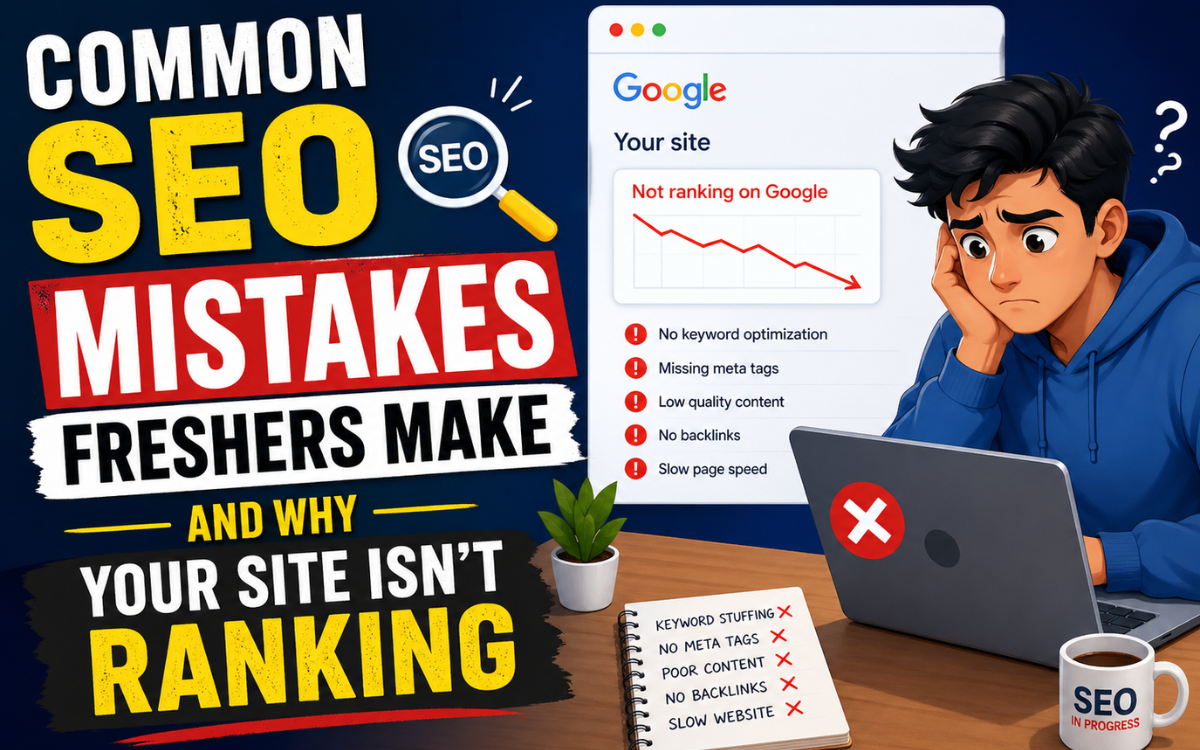
You built the website. You published the content. You waited. And yet, Google seems to have completely ignored you. Sound familiar? If you are just starting out in SEO, you are almost certainly making at least a handful of the common SEO mistakes that hold millions of websites back from ranking. This guide breaks them all down, and more importantly, shows you how to fix them.
1. Ignoring Keyword Research Entirely
The first and perhaps most damaging of all common SEO mistakes is skipping keyword research. Many freshers write content based on what they think people search for, not what they actually type into Google. Without keyword data, you are essentially writing into a void.
Keyword research tells you exactly what your target audience is looking for, how often they search for it, and how competitive those queries are. Without this foundation, even beautifully written content will never reach the right people.
Fix: Use free tools
- Google Keyword Planner for volume data
- Ubersuggest or Ahrefs Free Tier for ideas
- Google’s autocomplete and “People Also Ask” for real intent
- Target a primary keyword and 3–5 related terms per page
2. Targeting Keywords That Are Too Competitive
A new website trying to rank for “best smartphones” or “digital marketing” is like a local bakery trying to compete with McDonald’s on the first day of opening. Freshers often aim too high, targeting broad, high-volume keywords dominated by authoritative sites with thousands of backlinks.
A brand-new website has almost zero domain authority. Ranking for competitive head terms within the first year is extremely rare without significant resources.
The smarter play is to target long-tail keywords, specific, lower-competition phrases like “best budget smartphone under 15000 in India 2026.” These are easier to rank for and often convert better because the searcher’s intent is more specific.
Fix: Start with long-tail, build authority, scale up
3. Writing Thin, Shallow, or Duplicate Content
Google’s algorithms are sophisticated enough to evaluate the depth and quality of your content. Publishing 300-word blog posts that skim the surface of a topic is one of the most common SEO mistakes in 2024. Thin content provides little value to the reader and little signal to the search engine.
Even worse, some beginners copy content from competitor websites and republish it. Duplicate content, whether copied from others or duplicated across your own site, confuses search engines and can result in ranking penalties.
- Aim for at least 1,000–1,500 words for informational posts
- Cover the topic more thoroughly than the top-ranking pages
- Use original insights, examples, and visuals
- Never copy-paste from another source, always rewrite
4. Missing On-Page SEO Fundamentals
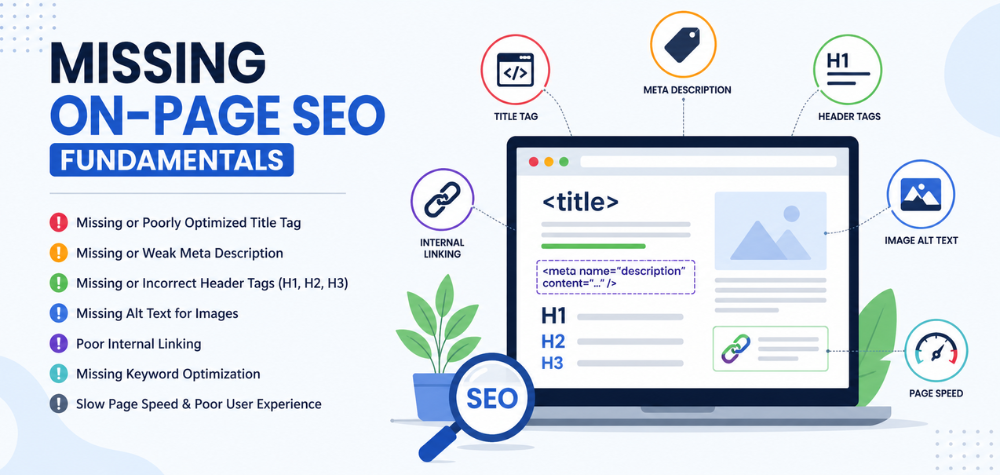
On-page SEO is the foundation that tells search engines what your content is about. Freshers frequently publish pages without the basic signals in place, and then wonder why they are not ranking.
Every page you publish needs these non-negotiables properly configured before it has a real chance of ranking.
✓ On-page checklist for every page
- Title tag includes primary keyword and is under 60 characters
- Meta description is compelling and under 155 characters
- One H1 tag per page – containing the target keyword
- H2 and H3 headings used to structure the content logically
- Keyword appears naturally in the first 100 words
- Image alt text describes the image and includes keywords where relevant
- URL is short, clean, and includes the keyword
5. Neglecting Technical SEO
Many beginners focus entirely on content while ignoring the technical infrastructure that allows Google to crawl and index their site properly. If Googlebot cannot access your pages, your content simply will not exist in search results.
A broken sitemap, a misconfigured robots.txt, or noindex tags left by accident can prevent your entire website from appearing in Google, even after months of publishing.
- Submit your XML sitemap to Google Search Console
- Ensure robots.txt is not accidentally blocking important pages
- Fix broken links and 404 errors regularly
- Use HTTPS, Google treats it as a ranking signal
- Keep page speed fast, aim for Core Web Vitals scores in the green
6. Ignoring Mobile Optimisation
Google now uses mobile-first indexing, which means it primarily uses the mobile version of your site to determine rankings. A website that looks great on desktop but breaks on mobile will suffer significantly in search results. With over 60% of global web traffic now coming from mobile devices, this is no longer optional.
Test your site on multiple screen sizes, ensure font sizes are readable, buttons are tappable, and there is no horizontal scroll. Use Google’s free Mobile-Friendly Test to identify issues quickly.
7. Poor or Non-Existent Internal Linking
Internal links, links from one page on your site to another, serve two critical purposes: they help Google discover and crawl your content, and they distribute page authority across your site. Yet internal linking is consistently one of the most overlooked common SEO mistakes among new website owners.
When you publish a new article, link to it from existing related posts. Use descriptive anchor text (not just “click here”) that tells both users and search engines what the linked page is about. A well-structured internal linking strategy can significantly boost the visibility of your most important pages.
8. Not Building Any Backlinks
Backlinks — links from other websites pointing to yours -are one of Google’s most important ranking signals. They act like votes of confidence from the web. A site with zero backlinks will struggle to rank for anything competitive, no matter how good the content is.
You do not need to resort to spammy link schemes. Start with these legitimate, beginner-friendly link-building methods:
- Guest posting on relevant blogs in your niche
- Creating genuinely shareable resources, tools, or infographics
- Reaching out to bloggers who have linked to similar content
- Listing your site in genuine, relevant directories
- Building relationships with others in your industry
9. Expecting Results Overnight
Perhaps the most emotionally crushing of all common SEO mistakes is the expectation of fast results. SEO is a long-term strategy. A brand-new website can take 3-6 months to begin seeing meaningful organic traffic, and 12–18 months to establish real authority in competitive niches.
Freshers who do not see results in 30 days often give up, or pivot to paid ads without understanding organic fundamentals. This impatience is what separates those who eventually succeed in SEO from those who don’t.
Stay consistent. Publish quality content regularly. Build links steadily. The results compound over time – and once they arrive, organic traffic is one of the most cost-effective channels available.
10. Ignoring Analytics and Search Console Data
Publishing content without tracking its performance is like driving blindfolded. Google Search Console and Google Analytics are free tools that provide invaluable insights – yet many freshers either do not set them up, or set them up and never look at them.
- Search Console shows which queries bring impressions and clicks
- Analytics shows user behaviour, bounce rate, time on page, conversions
- Identify pages with high impressions but low CTR – improve the title and meta
- Find pages ranking on page 2 – optimise and build links to push them to page 1
The Bottom Line
SEO success for beginners is not about magic tricks or gaming the algorithm. It is about avoiding the common SEO mistakes outlined above and consistently doing the fundamentals well. Start with solid keyword research, create genuinely helpful content, fix your technical foundations, build backlinks patiently, and track your results. Do this consistently over 12–18 months and your website will rank – it is not a question of if, but when.
The websites that rank on Google’s first page are not there by accident. They are there because someone did the work, avoided the shortcuts, and played the long game. You can do the same.