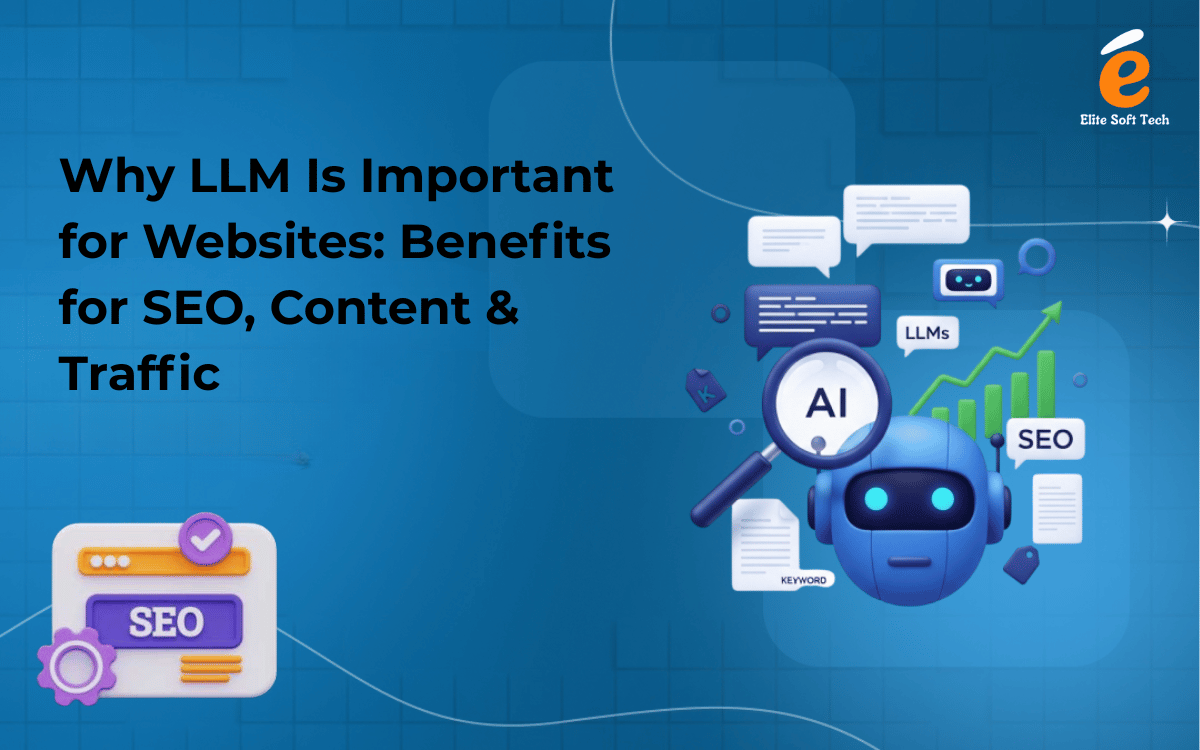
Due to advances in LLM technology, the digital landscape is rapidly changing, and as such, it is imperative to understand what LLMs are and how they can help your online presence, as this type of technology can enhance any digital property.
LLMs will transform websites in every way, from improving search engine rankings to generating superior content to driving organic traffic to sites. In this blog, we will discuss why LLMs are important for websites and how they can be used by you to outperform competitors.
What Is a Large Language Model (LLM)?
The Large Language Models can be defined as artificial intelligences that have been created using a large amount of content, such as written text or a collection of texts, trained using a deep network architecture known as transformers. The transformer network was developed by Google in 2017 and has become a strong foundation upon which to build other AI applications. Through the learning of language structures and reminiscent patterns within written language, LLMs can produce, translate, summarize and understand huge volumes of written texts with above average accuracy.
Google Cloud states that these models are trained on billions of pieces of written text and are highly adaptable due to the fine-tuning capabilities available after initial training for a variety of tasks, such as writing content, translating materials into another language, analysing the overall sentiment of a document/communication or answering questions via a written format. A great example of the current generation of multimodal LLMs is Gemini, developed by Google due to its ability to process and understand written texts, images, videos, and code concurrently.
For website owners, this means one thing: access to a technology that can fundamentally improve how your site communicates, ranks, and converts.
LLM and SEO: A Game-Changing Relationship
Search Engine Optimisation (SEO) is the cornerstone of organic website growth. LLMs are transforming SEO in several powerful ways:
1. Semantic Search Optimisation
Modern search engines like Google do much more than just match your keywords; they understand what your intent is. LLMs (Large Language Models) provide semantic knowledge, which helps search engines to understand what someone is searching for or looking to accomplish. When you create content based on how LLMs perform their analysis, it causes you to write in a manner that is compatible with how the search engine measures relevance and context, as well as intent. Therefore, you will get better rankings without having to use keyword stuffing.
2. Automated Meta Descriptions and Title Tags
LLM-based applications quickly create great SEO-optimised title tags as well as meta descriptions for hundreds of pages in an instant. You will not need to do this manually, which saves you time, and every one of your website’s pages will be better optimised for search engines. Previously, this was a difficult job that took a long time to do properly and inconsistently.
3. Keyword Clustering and Topic Modelling
LLMs excel at analysing large volumes of keyword data and grouping them into topic clusters. This allows SEO teams to build authoritative content pillars that cover a subject comprehensively — a structure that search engines reward with higher rankings and improved domain authority over time.
4. Voice Search and Conversational Query Optimisation
As voice search becomes more common, users are increasingly using everyday, casual language to make inquiries. Since large language models use human language patterns to generate their outputs, they enable you to produce content that is similar to how people talk. Having your website be similar in content to how people speak increases the chances that it will show up in voice searches and be included in featured snippets.
How LLMs Supercharge Website Content Creation
Web traffic is generated by the content itself-this is what keeps your audience engaged (by providing them with what they want), creates credibility for your company, and establishes you as an authority in your industry. Here’s how LLMs can help content teams to achieve the above objectives:
Faster Content Production at Scale
One of the most immediate benefits of LLMs is the ability to produce large volumes of high-quality content quickly. Blogs, product descriptions, landing page copy, FAQs, and social media posts can all be drafted in a fraction of the time it would take a human writer alone. This allows businesses to maintain a consistent publishing schedule, which is critical for both audience retention and SEO performance.
Personalised Content Experiences
LLMs make personalisation scalable. By analysing user behaviour data, an LLM-powered system can generate or recommend content that is tailored to an individual visitor’s interests, purchase history, or browsing patterns. Personalised content dramatically improves engagement metrics such as time-on-site, pages-per-session, and conversion rates.
Multilingual Content Without Extra Cost
Typically, expanding your site to reach foreign markets has taken significant investment in employing translation teams. Because of LLMs, however, you can get nearly human-quality translated text for dozens of languages at minimal cost. This means there are whole new markets available to you and significantly larger audiences for everyone who uses a website.
Content Repurposing and Summarisation
LLM can convert long-form blog posts to a summary or a social media thread or an email newsletter, or a video script automatically using AI-based technology. Thus, you will be able to derive maximum use out of each piece of content produced by your team, as you will have repurposed that single body of work into multiple formats.
LLMs and Website Traffic: Driving Sustainable Growth
Ultimately, the goal of every website improvement is to attract more of the right visitors. LLMs contribute to traffic growth in several direct and indirect ways:
- Improved SERP Rankings: Better-optimised content produced with LLM assistance tends to rank higher in search results, directly driving more organic traffic.
- Chatbots That Convert: LLM-powered chatbots engage website visitors in real-time, answer questions, guide purchasing decisions, and reduce bounce rates – all of which signal quality to search engines.
- Reduced Bounce Rates Through Relevance: When content is genuinely relevant and well-structured (thanks to LLM-assisted optimisation), visitors stay longer, explore more pages, and are more likely to return.
- Smarter Internal Linking: LLMs can analyse your entire content library and suggest optimal internal linking structures, keeping users on your website longer and distributing SEO authority more effectively across pages.
Google Cloud’s LLM Ecosystem: Enterprise-Ready AI for Websites
The Google Cloud AI platform is one of the largest and most enterprise-focused providers of LLM capabilities available today. Different LLMs are available, such as Gemini, a next-generation multimodal LLM with the best-in-class reasoning and generation capabilities.
Google Cloud provides a variety of LLM services, such as creating intelligent chatbots using the Vertex AI Agent Builder and deploying conversational AI using the Customer Engagement Suite, and access to pre-built APIs for natural language processing. New customers can receive $300 in free credits to make this platform affordable for smaller teams interested in adding LLM capabilities to their websites for the first time.
Because the Google Cloud infrastructure is scalable, both startups and enterprises can add LLM-powered features that will continue to be able to scale with their business growth without needing to manage a large, complex infrastructure.
Practical LLM Use Cases for Website Owners
Here are some real-life examples of real businesses using LLMs to improve their operations.
E-commerce – They are using LLMs to automatically generate unique product descriptions for thousands of products in order to improve conversion rates and SEO.
News-Media – They are using LLMs to summarise long reports, transcribe audio files, and create first drafts of articles for human editors to edit later.
SaaS-Tech – They are using LLMs to power intelligent documentation searches and to build AI-powered support chatbots, both of which are reducing customer service costs.
Healthcare – They are using LLMs to summarise accurate and contextually relevant health information to meet industry standards.
Education – They are using LLMs to create adaptive learning materials, evaluate written responses automatically, and create individual study paths based on student performance data.
Important Considerations When Using LLMs on Your Website
The advantages that LLMs provide are phenomenal, but their use must be carefully monitored and implemented appropriately to be effective. There are several ideas to consider when using LLMs:
•Human Oversight Remains Important: Always have LLM-developed content reviewed and approved by a human editor for accuracy, brand voice and factual correctness prior to publishing.
•Originality and Quality are Crucial: Search engines have become very proficient at detecting poor-quality, generic content produced by an LLM. LLMs should be utilised as an assistance tool to support authentic experts, not as a replacement.
•Data Privacy: When implementing any LLM-based products, ensure compliance with applicable data privacy laws, such as GDPR and/or CCPA, when personalising content based on user data.
• Utilising the Appropriate Platform: Enterprise-level platforms, such as Google Cloud’s Vertex AI, provide comprehensive security, compliance, scalability and other capabilities that free or low-end tools cannot provide.
Conclusion: The Future of Websites Is Powered by LLMs
LLMs (Large Language Models) are now available for many organisations to use and implement as they become an integral part of the digital ecosystem. LLMs are becoming very popular because they provide a practical and reliable means of transforming any website’s performance. Websites can take advantage of LLMs by enhancing their SEO rankings, speeding up their content creation processes, generating higher levels of qualified traffic, and creating tailored user experiences to connect with visitors.
By implementing LLMs into your business today, you are making a strategic move that will give your business a considerable edge over your competition in the future. With options like adding a smart chatbot, automating content creation, or using an enterprise-level AI tool such as Google Cloud Vertex AI, any progressive step you take now in the direction of LLMs for your website will ultimately put you on the path toward a more successful, efficient digital presence.