In today’s digital landscape, creating quality content is only half the battle. The other half involves getting that content in front of the right audience. This is where blog submission becomes a game-changer for businesses, marketers, and content creators alike. Understanding blog submission and leveraging it effectively can significantly amplify your online visibility and drive meaningful traffic to your website.

The process of submitting your Blog is known as Blog Submission. You submit or publish your blog posts on directories, content aggregation sites, and submission sites for blogs. These sites act as centralized places for readers to find new, relevant content within many niches and categories. Blogging and blog submission give readers easy access to fresh, relevant blog posts from many different sources in one location. So by using these sources, you are putting your blogs in a digital market where potential readers can find them when they look for information.
By submitting your blog to multiple sources, you will be able to broaden your reach beyond your own website. This is not only a good way to share your knowledge with more people; it is a way to make sure that the information you have developed as a blogger will reach the most people possible, and that is an important part of your blog submission process.
Increasing Online Presence: By submitting your blog to several directories, you open up multiple ways for users to find & view your content. Each entry into a directory serves as a guiding light for potential readers from every corner of the internet, leading them to your field of expertise.
Google Ranking/SEO Benefits: Search engines prefer diverse backlink profiles when ranking websites (ie; sites with different backlinks). High-quality blog submission sites give users good backlinks, which help add authority to your website’s domain and improve its rankings in search engines. These new backlinks are good indicators to search engines that content is credible enough for higher ranking.
Audience Targeting: Blog submission directories are usually categorized (niche/industry). This allows you to reach people that have an interest in your subject matter—therefore thus increasing the possibility of engaging & converting your content.
Building Credibility: Consistent submission of your blog demonstrates your presence on multiple platforms, positioning you as being a thought leader in that niche. As a result, after coming across your content on many reputable websites, people begin to recognize you as an expert within that niche.
Budget Friendly Marketing: Many blog submission sites are free or low cost compared to the price associated with advertising. By utilizing blog submission as part of your marketing plan, your business can take advantage of inexpensive methods of reaching people’s attention and generating leads.
| Website | DA | PA* | Country | Niche |
| WordPress.com | 92–100 | 90+ | Global (US) | GEN (Blog Platform) |
| Blogger.com | 100 | 85+ | Global (US) | GEN |
| Medium.com | 95 | 85+ | Global (US) | GEN / PUB |
| Tumblr.com | 92 | 70+ | Global (US) | GEN / SOC |
| Weebly.com | 95 | 80+ | Global (US) | GEN / SMB |
| Wix.com | 93–96 | 85+ | Global (Israel/US) | GEN / SMB |
| Squarespace.com | 97 | 88+ | US | GEN / SMB |
| Ghost.org | 85–90 | 70+ | Global (US) | BLOG / TECH |
| Substack.com | 90 | 75+ | US | NEWS / BLOG |
| Typepad.com | 80–85 | 65+ | US | GEN |
| LiveJournal.com | 85–92 | 70+ | Global (US) | GEN |
| Write.as | 80–85 | 60+ | US | BLOG |
| Penzu.com | 75–80 | 55+ | US | BLOG / PERSONAL |
| HubPages.com | 92 | 80+ | US | GEN / ARTICLE |
| Bloglovin.com | 90 | 70+ | US | BLOG / FASHION |
| Kinja.com | 90 | 70+ | US | NEWS / MEDIA |
| Scribd.com | 94 | 85+ | US | DOC |
| Sites.Google.com | 96 | 90+ | Global (US) | GEN |
| Quora.com | 93 | 75+ | Global (US) | QNA |
| LinkedIn.com | 99 | 95+ | Global (US) | BUS / PROF |
| Medium.com/Publications | 95 | 80+ | Global | GEN |
| Reddit.com/r/blogs | 97 | 85+ | Global (US) | SOC / COM |
| ArticleCube.com | 50 | 40+ | US | ARTICLE |
| SooperArticles.com | 55 | 45+ | US | ARTICLE |
| EzineArticles.com | 80–90 | 70+ | US | ARTICLE |
| SeekingAlpha.com | 90 | 80+ | US | FIN |
| eHow.com | 90 | 75+ | US | EDU / HOWTO |
| BiggerPockets.com | 85–90 | 75+ | US | REAL ESTATE |
| BrightHub.com | 80–85 | 65+ | US | EDU |
| Buzzle.com | 70 | 60+ | US | ARTICLE |
| Examiner.com | 80 | 70+ | US | NEWS |
| Squidoo.com* | Inactive | — | US | ARTICLE |
| APSense.com | 75–80 | 60+ | US | BUS / SOCIAL |
| HubPages.com | 92 | 80+ | US | GEN |
| BlogEngage.com | 60 | 50+ | US | BLOG |
| ArticleCity.com | 70 | 60+ | US | ARTICLE |
| SelfGrowth.com | 80–85 | 65+ | US | SELF DEV |
| ArticleAlley.com | 65 | 55+ | US | ARTICLE |
| IdeaMarketers.com | 70 | 60+ | US | BUS |
| iSnare.com | 75 | 60+ | US | ARTICLE |
| ArticleDashboard.com | 60 | 50+ | US | ARTICLE |
| ArticleBase.com | 65 | 55+ | US | ARTICLE |
| ArticleCube.net | 77 | 60+ | US | ARTICLE |
| ArticleSnatch | 79 | 60+ | US | ARTICLE |
| ArticleSubmitter | 78 | 60+ | US | ARTICLE |
| ArticlePR | 79 | 60+ | US | ARTICLE |
| ArticleSphere.org | 78 | 60+ | US | ARTICLE |
| ArticlePostingSites | 77 | 55+ | Global | ARTICLE |
| ArticlePost | 78 | 55+ | Global | ARTICLE |
| ArticleMall | 77 | 55+ | US | ARTICLE |
| ArticleGarden.org | 78 | 60+ | US | ARTICLE |
| ArticleHub | 77 | 60+ | Global | ARTICLE |
| ArticleHive | 78 | 60+ | Global | ARTICLE |
| ArticleSpot | 77 | 60+ | Global | ARTICLE |
| ArticleWorld | 78 | 60+ | Global | ARTICLE |
| ArticleDesk | 77 | 60+ | Global | ARTICLE |
| ArticlePlanet | 77 | 60+ | Global | ARTICLE |
| ArticleLand | 77 | 60+ | Global | ARTICLE |
| ArticleVista | 77 | 60+ | Global | ARTICLE |
| ArticleOcean | 77 | 60+ | Global | ARTICLE |
| ArticlePanda | 76 | 58+ | Global | ARTICLE |
| ArticleBunny | 75 | 58+ | Global | ARTICLE |
| ArticleFox | 74 | 55+ | Global | ARTICLE |
| ArticleGator | 73 | 55+ | Global | ARTICLE |
| ArticleLynx | 72 | 55+ | Global | ARTICLE |
| ArticleMole | 71 | 55+ | Global | ARTICLE |
| ArticleNinja | 70 | 55+ | Global | ARTICLE |
| ArticleOwl | 69 | 50+ | Global | ARTICLE |
| ArticlePenguin | 68 | 50+ | Global | ARTICLE |
| ArticleQuail | 67 | 50+ | Global | ARTICLE |
| ArticleRabbit | 66 | 50+ | Global | ARTICLE |
| ArticleSparrow | 65 | 50+ | Global | ARTICLE |
| ArticleTiger | 64 | 50+ | Global | ARTICLE |
| ArticleBase.info | 78 | 60+ | US | ARTICLE |
| ArticleBank | 79 | 60+ | US | ARTICLE |
| ArticlesGratuits | 78 | 60+ | France | ARTICLE |
| Blogarama | 85 | 70+ | US | BLOG DIRECTORY |
| Pen.io | 80 | 65+ | Global | BLOG |
| Edocr.com | 86 | 70+ | US | DOC |
| Issuu.com | 92 | 85+ | US | DOC |
| Slideshare.net | 93 | 85+ | US | DOC |
| AuthorsDen.com | 84 | 70+ | US | ARTICLE |
| OpenPR.com | 90 | 75+ | Germany | PR |
| PRLog.org | 88 | 75+ | US | PR |
| PR.com | 89 | 75+ | US | PR |
| ArticleFriendly | 78 | 60+ | US | ARTICLE |
| MyArticle | 77 | 60+ | Global | ARTICLE |
| ArticleDepot | 78 | 60+ | US | ARTICLE |
| ArticleBoss | 78 | 60+ | US | ARTICLE |
| ArticleHotline | 77 | 60+ | US | ARTICLE |
| ArticleBlast | 78 | 60+ | US | ARTICLE |
| ArticleBase.org | 77 | 60+ | US | ARTICLE |
| ArticleCube.net | 77 | 60+ | US | ARTICLE |
| ArticleSnatch | 79 | 60+ | US | ARTICLE |
| ArticleSubmitter | 78 | 60+ | US | ARTICLE |
| ArticlePR | 79 | 60+ | US | ARTICLE |
| ArticleSphere.org | 78 | 60+ | US | ARTICLE |
| ArticlePostingSites | 77 | 55+ | Global | ARTICLE |
| ArticlePost | 78 | 55+ | Global | ARTICLE |
| ArticleMall | 77 | 55+ | US | ARTICLE |
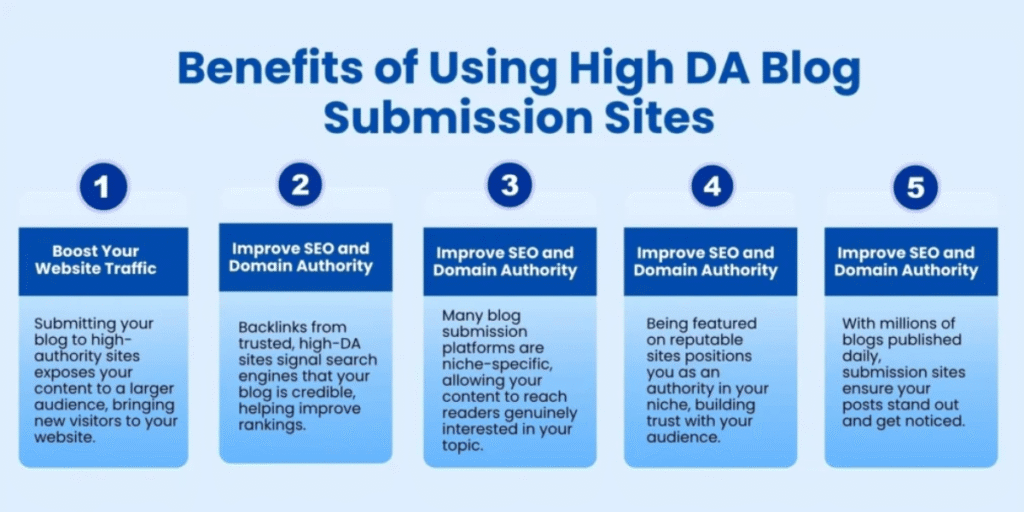
He advantages of blog submission extend far beyond basic visibility. Here’s what you can expect:
More Traffic to Your Site: Blog submissions add back-ways to your site. Posting quality articles with solid content will encourage people to follow links back to your website, look for other things on your site, and many may become leads or prospects.
Better Again with Google: Make backlinks from your blogs (not to your blogs). The more sites that link to your blog, the better for your SEO. Proper back-linking through authoritative directories means improved results in Google searches.
Speedy to Get Indexing: Search bots often visit the same directories multiple times a week when indexed. Consequently, when you use blog submission services, the search engines index your articles on the same day or in the case of some, only a few days after submission.
Finding New Contacts: Many blogs are databases for writers, marketers, and people in many professions. Building relationships there can lead to guest posting or partnerships with others in your industry.
Continued Value in Your Content: Blog directories continue to provide ongoing value to your content. Old articles can still generate traffic or inquiries a month, six months, or even years after the date they were posted.
Researching: Through tracking your submissions, you will be able to determine which topics or styles of writing perform the best, what your audience is looking for, and what content could be added to make your industry more complete.
Blog submission isn’t a one-size-fits-all strategy. Understanding the different types helps you choose the right approach for your goals:
Free Blog Submissions – platforms that provide you with the opportunity of submitting your content free of charge; however, these great resources may have some limitations in relation to the features they offer, how many submissions you can submit per day, or their ability to help you promote your content.
Paid Blog Submissions – Many premium directory listing services will charge a fee to submit your blog. However, these types of services usually perform better, get approved faster, have higher ranking placements, give do-follow links back to your site, and have better overall visibility. These are well worth paying for when you have high-quality content that you want viewers to access.
Manual Blog Submission – This is the process of manually submitting your blog to blogs and directories by providing each one with customized information and submitting to the right category. Although this takes longer than using automated submissions, typically manual submissions yield better results and more approvals than automated submissions.
Automated Blog Submission – There are software tools available that allow you to automatically submit your blog to numerous directories at one time. While these can be very effective in saving time, they can also result in lower rates of approval or less desirable placements.
Niche-specific submissions – To ensure your blog content is getting into the hands of a highly targeted audience, be sure to submit your blog to niche-specific directories that cater to specific industries or topics.
General blog directories – These directories are for all types of blog categories and industries; therefore, these directories offer you greater exposure but may not provide you with as targeted an audience as you would like for your blog content.
Micro blogs are another type of blog submission strategy (i.e., micro blogging). Micro blogs allow users to post quick updates, ideas, or information about something in short pieces of content (range 200-500 words or less).
Examples of popular micro blogs are Twitter, Tumblr, and the shorter format of Medium. Micro blogs are also designed for quick consumption and sharing; therefore, they can be utilized for timely updates, snippets of thought leadership, and to drive traffic to longer pieces of written content.
The benefits of micro blogging are immediate interaction with an audience, quicker creation of new content, and the ability to maintain an ongoing online presence (without taking the time to write a full-length blog). The digestible nature of micro blogs often results in an increase in the number of people that share them through social media platforms.
Article submission and blog submission terms may seem to have a lot of similarities; however, they are very different in many ways that can affect your content strategy.
Structure and Format: Articles typically use very formal writing rules, structured sections, citations, and objective reporting in the typical way (Chicago style); whereas blogs use a more casual style of writing, normally in the first person, with a personal view of the topic, and a more flexible format.
How Long: Generally speaking, an article is longer than a blog post (usually greater than 1,500 words) and has a more extensive analysis. Blog posts can be any length; however, they generally emphasise on how easy they are to read and communicate clearly to the reader compared to providing detailed information.
Where to Publish: Generally speaking, article submissions will be directed at article directories, academic sites/portals, and publication sites that feature evergreen, or informative types of articles. Blog submissions generally target directories and other types of sites that feature blogs which focus on current topics with a little bit of personality, or interest.
How They Affect SEO: Article directories typically provide better links back to your site because they are generally considered to be more authoritative, but they also have clear guidelines for submitting articles. Blog directories usually have easier submission options to them, but their overall SEO value can be different.
What Do the Readers Expect:Â Typically people reading articles will want to find an in-depth, documented, and well-researched answer to their question. People choosing to read a blog will usually want to read something that relates to them and contains ideas and stories from people like them.
How Often Are They Updated?: Blogs typically do their best to provide a regular stream of new content and to have a fresh perspective on different subjects, whereas article content typically provides a long life span because they rely on research and timeless material.
To effectively gain the most from blogging submissions, focus on writing high-quality content that‘s unique and offers real value. Research and select appropriate directories that fit your niche and write to their submission guidelines using proper keyword choice and meta descriptions as per submission. Continue to focus on your submission schedule and use analytics to track which platforms provide you with the best traffic so you can adjust your strategy based on your findings. Remember to focus on high–quality submissions instead of the quantity of blog submissions.
Blog Submission – A Digital Marketer‘s Best Friend. Understanding the Purpose of Blog Submission; The Benefits of Blog Submission; The Different Types of Blog Submissions; The Difference Between Blog Submissions & Article Submissions; A Comprehensive Content Distribution Strategy (for your online presence); Building your Business and/or Personal Brand Effectively Via Blog Submission. It‘s important to know that regardless of whether you use free or paid blogging platforms, manually or automatically submit to blogging sites, or combine microblogging with your blogging strategy, the main factor is that you consistently deliver high–quality content via strategically selected blog submission platforms that meet the needs of your target audience.