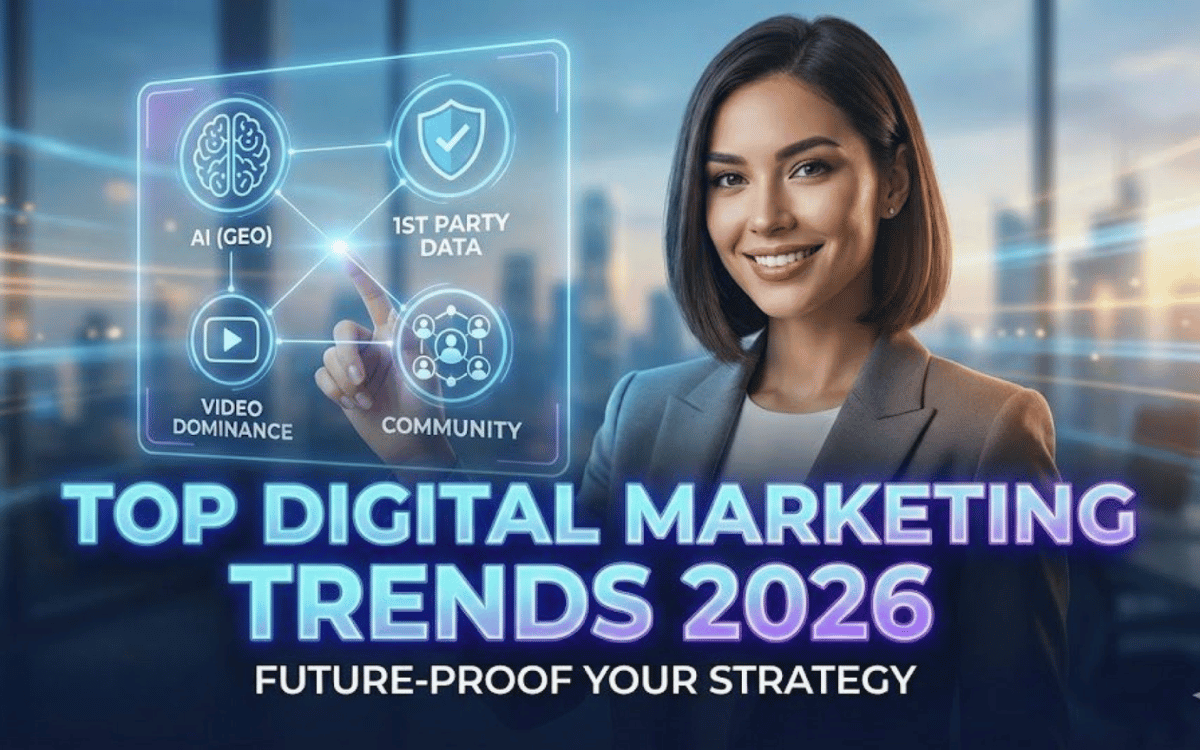
Digital marketing is at the crossroads. As we find our way through the years of 2026, digital marketers find themselves experiencing the most unusual and unprecedented level of transformation because of artificial intelligence, changing legislation regarding privacy, and changing consumer behaviors. A reality where the main goal was to reach and target the audience effectively now requires real engagement, artificial intelligence, and foresight. Understanding this new reality is not only important to be ahead of the game, but to survive as well.
The AI Revolution: Experimentation To Execution
The future of digital marketing in the year 2026 is inherently shaped by artificial intelligence, which will mature from a research application to a primary operating system. The goal of Meta Platforms is to automatically carry out advertising through artificial intelligence by the end of 2026, where soon the brand will be able to provide the image of the product and the budget to let artificial intelligence create the advertisement, target, and optimize it.
What began with creative shortcuts in the year 2025 will culminate in the deployment of fully autonomous marketing activities. Artificial intelligence applications will not only help but design, implement, and optimize overall marketing campaigns with very little human intervention. Online marketing automation will transform and evolve from being based on scheduled processes to the use of self-optimizing systems that both design, execute, and optimize marketing activities based on the real-time channel and timing optimization.
However, with the automation that AI brings, there are important challenges too. More than half of the group cite “inaccurate, unreliable, or inconsistent output quality” as the most important limitation of AI-powered tools. Although AI speeds up the process of production, it has not eliminated the need to apply human judgment and strategy. “Organizations that achieve the most success in 2026 adopt a “human-in-the-loop” approach where AI runs at scale and humans decide strategy, prevent bias, and protect brand safety.”
Generative Engine Optimization: The New SEO
The search strategies in digital marketing are undergoing a radical change in the future. SEO models that were based upon searching a particular set of key words or phrases in search engines for a particular ad campaign are soon going to be replaced by Generative Engine Optimization. The intent would no longer be upon bidding keywords in a ad campaign, but preparing a library that would be used in a search campaign conducted by AI engines.
Now, summary results are given for all search questions before users choose to visit websites, resulting in a revolution in traffic patterns. Although AI generates fewer visiting traffics, it is more conversion-oriented. Users search within Chat GPT, Perplexity, and AI Overviews and come back directly to websites for conversion. Therefore, it is crucial to feature within summary results instead of only link performance.
The message is clear: it is up to the marketer to create authoritative, person-first content that helps with AI-powered conversational query questions rather than solely thinking about search engines. Rich ecosystems of content, structured data, and entity-filled topical depth become a phenomenal competitive advantage.
Privacy-First Marketing: From Compliance to Competitive Advantage
The digital marketing landscape is being transformed by a tidal wave of privacy laws. Currently, eight privacy laws are fully up and running at the state level within the US, with plans to enact more by 2026. Other major economies within Asia, including India, Japan, and Sri Lanka, have overall data protection. These developments mean that the EU AI Act is no longer theoretical but practical.
It must be noted that these rules and regulations act as more than just hurdles – it acts as catalysts in radical changes to a firm’s strategy. The factors leading to this transition, be it regulations related to privacy, limitations by browsers, or demands by consumers, only lead to acceleration and not reversal. Third-party cookies don’t exist anymore, and tracking anyone through their online presence only deteriorates with each passing day.
It leads to a bifurcated market. Successful firms possess best-in-first-party-data skills. They deliver targeting, measurement, and experiences that were unattainable before. Others relying on third-party data face deteriorating results and higher costs. First-party data will transition from a “nice-to-have” resource to the primary currency for personalization.
Creating Trust through Transparency
The future of digital marketing success is going to be based on clear and transparent value exchanges. The role of marketers will no longer be based on opaque tracking, and instead, they will focus on facilitating the process of value exchange, in which consumers will themselves provide them with information in exchange for personalization and other perks. Studies show that consumers are willing to pay higher to buy products from brands they trust to maintain their data privacy.
The collection of zero-party data, or the type of information consumers actively share with the brand, thus becomes the new pivotal competitive tool. Instead of secretly acquiring consumer behavior, the best companies of 2026 establish attractive incentives to share preferences, intentions, and individual information.
Clean rooms, in which encryption methods are used to match data records in one set of data with data in another while protecting the privacy of the customers, have seen an enormous adoption rate. All the key advertising players have developed the ability to do clean rooms, and knowing how to use them has become required knowledge for performance marketers.
Agentic AI: Marketing’s New Gatekeepers
Perhaps the most transformative factor in the future of digital marketing is the emerging reality of Agentic AI – assistant systems. Agentic AI systems have the potential to disrupt digital markets by providing consumers with automated systems capable of researching, comparing, and even making a transaction without having to visit a variety of websites.
The Atlas browser by ChatGPT and the browser by Perplexity are examples of this paradigm shift, as they are capable of performing tasks such as searching for products, evaluating alternatives, and even finalizing purchases without the user ever leaving the AI environment. As such, it introduces a whole new level to the marketing technology stack, as it operates as the middleman between the prospect and the brand, interpreting and relaying the information summarized without the user actually engaging with the brand.
The traditional digital experience playbook relied on the customer visiting brand touchpoints where the brand told its own story. This brand storytelling paradigm completely falls apart in the presence of Agentic AI. Brands are now faced with the challenge of optimizing for discovery and recommendation in Agentic AI systems, which may never actually send users to their website.
The key to success is establishing genuine authority through valuable content, high-quality partnerships, and a strong branded signal across the entire digital environment. It’s not just about optimization today; it’s about being a trustworthy source of information that AI bots recognize as authoritative in particular domains.
Creating Content: From Automation to Authenticity
It is true that AI is democratising content creation, and ironically, the future of digital marketing requires more authentic and human-focused creative efforts. Gartner has moved GenAI into the Trough of Disillusionment, as the realities of using AI-generated content have sunk in with the marketer crowd. The amount of AI-slop, non-descript algorithmically created content, is up, and engagement metrics show it is uninteresting and ineffective.
The fact that firms like Clay and Ahrefs are employing a ton of in-house staff who are socially active and posting top-of-funnel content that helps Spread their brand has a lot to do with this movement. This addresses two pressing needs because now there are no costs associated with hiring staff from outside, and messages are stronger because these people understand them correctly and can in fact explain them effectively.
The audience today is not passive consumers of the story – it is someone who wants to ‘join in’ and ‘remix’ the story. The audience is looking for ‘Creative Maximalism’—and the ‘creators’ are driving this trend of ‘participation’.
Comment: Brands must facilitate audience participation and not only share their messages.
The most effective content marketers in 2026 apply AI to content creation and scaling, but supplement these efforts with human expertise to offer insight, emotional intelligence, and brand voice. Such an approach will help increase efficiency while maintaining authenticity that delivers results.
Measurement and Attribution: From Precision to Modeling
The future of measurement in digital marketing is going to be much different from what we saw in the last decade in terms of attribution. The traditional methodology of attribution (last click, multi-touch) is breaking down due to challenges of privacy, walled gardens, and cross-device fragmentation. Marketing Mix Modeling is going to be the bastion in linking media dollars to business results.
Open-source solutions also have applications in combining online and offline channels with walled garden signals, where a marketer can prove incremental lifts and return on investment rather than proof of actions such as merely information or click-through rates. The entire process demands a paradigm shift in the way the marketing departments function.
Revenue is one of the sources of truth that remains most accurate when confronted with discrepancies between platform metrics. The most robust methods of measurement involve selectively using a short list of key performance indicators, as opposed to trying to normalize data from all possible sources. This represents an evolution of marketing intelligence analysis from data maximization to meaningful intelligence.
Conversion tracking needs to be perfect for AI optimization to happen properly. When there are errors or inefficient conversions in the process of tracking, the optimization of AI is done for the wrong objectives, thus wasting money and minimizing performance. Accurate conversions will now form the root of all optimization automation.
Omnichannel integration, the process of stitching together
The future of digital marketing requires integrated systems where the goal is to provide unified experiences for all touchpoints. Today, the average consumer is interacting with almost seven platforms on a monthly basis, fluidly transitioning between TikTok, Instagram, YouTube, Reddit, and various other online channels. The question needs to shift to focusing on how to bring all touchpoints into one single marketing effort.
This calls for both technology integration and organizational alignment. This could include the use of marketing automation software, CRM software, and analytic solutions that monitor interactions that take place on multiple channels, including those powered by AI agents.
Organized teams for separate interaction channels that function on their own cannot produce the merged experience needed by the consumer.
Social media has progressed from being an effective marketing platform to becoming an everyday means of offering customers consumer care. Brands that do not address online mentions that go unanswered or that take too long to respond will result in lost prospects and harm to brand reputation. It leads to consumer dissatisfaction since they experience poor loyalty.
The kinds of media that traded in retail commerce are now appearing in a host of other sectors. The auto, packaged goods, finance, and travel sectors are all employing retail models that serve a new purpose: joining data, media, and outcomes in a way that blurs distinctions between advertising, commerce, and experience.
Platform-Specific Strategies: Social as Search
The future of digital marketing takes into account that social giants have effectively become search engines. Using key words on captions, long-form content, lengthened Q&A sections, and short video content has become imperative. Social SEO ensures that brands are visible when consumers are searching for answers to questions on platforms like TikTok, YouTube, and Reddit.
Reddit, once a fringe platform, is now mainstream and influential in authentic purchasing decisions, particularly within B2B and tech-related areas. As the seventh-most visited site in the world, with 4.9 billion monthly views, it leads search engine outcomes; answers on either Google or ChatGPT are likely to include a link to Reddit. To succeed, one must engage with the site and its culture, rather than plainly doing any form of advertising.
Those that recognize social media with strategic top-of-funnel touchpoints retain discoverability, while those that ignore these touchpoints as search destination sites risk being lost in the ever more potent sites that drive purchase decisions more before reaching traditional sites.
Scalable Personalization: Moving Beyond Segmentation
“The future state of the online marketing is less about basic demographic targeting and more about real-time, one-to-one experiences. Every single consumer is going to see dynamic content, offers, and product recommendations based on their first-party data, behaviors, and predictive models.” “It’s more than a look-and-feel, superficial change – this is a conversion engine.”
Consumers expect personal interaction, but frustration sets in if this personalization isn’t there. There has been a forceful push for the implementation of data-driven communication messages, beyond the scope of manual processing capabilities. AI has made personalization possible on a large scale by processing thousands of data inputs for the purpose of sending marketing messages in a manner so personal that the customer feels understood.
Yet, good personalization must come with disciplined data foundations, enabled by Customer Data Platforms, advanced decisioning with Predictive Models and Machine Learning, and smooth activation enabled by Journey Orchestration solutions. The issue of governance for privacy, bias, and brand voice is where systems must begin making decisions on their own with the customer experience as the objective.
The democratization of artificial intelligence technology means that small to medium-sized businesses now have the ability to have the same level of personalization possible by large corporations. You can now take existing marketing technology and build upon that to level playing fields for competition.
Video and Immersive Experiences: Beyond Static Formats
The lines between entertainment, engagement, and commercial activity continue to be obscured. The use of augmented reality, virtual reality, game-based marketing campaigns, or live interactive solutions is helping the marketing industry go beyond the boundaries of static advertising to the creation of memorable experiences. Hypersocial video-sharing platforms are changing the manner of watching, with the trend now clearly moving from passive viewing to active engagement.
AI chops down the usual barriers of video production. Technology is now available to produce commercial-grade videos featuring avatars, edit videos instantly, and roll out localized content at scale. The result? All kinds of organizations now compete effectively in video-dominated spaces without incurring massive production costs.
For the digital marketing video of the future, however, the goal will be to find the middle ground where the best of both worlds meets: the efficiency of automation and the authenticity that viewers are demanding and wanting more of.
Sustainability and Purpose: From Promises to Delivery
The days of broad general corporate sustainability claims are behind us. No longer can marketers feel caught between growing consumer pressures to take action and an increasingly toxic atmosphere where one misstep leads to charges of greenwashing.
The future of digital marketing about sustainability involves focus on particular and quantifiable product attributes that are clearly sustainable, like durability or efficient use of energy. Ineffectual marketing involves highlighting a message about saving the planet. Effective marketing involves starting with a genuine message about the consumer need. As a result, sustainability becomes a natural fit.
Younger generations of consumers are scrutinizing brands’ authenticity regarding intention and values. They not only consume brand narratives but research and verify them to point out inaccuracies. Brands should prove these statements with real actions and actual commitments rather than marketing messages.
Growing Challenges of Bias, Transparency, and Ethics
The future of digital marketing is facing substantial ethical issues with the increased autonomy level of algorithms in customer interactions. Marketers must focus on unbiased targeting with the need for frequent audits and diverse data when training the algorithms. These are some ethical issues in the future of digital marketing.
Many artificial intelligence models are actually black boxes, where decisions are made but are impossible to explain or be accountable for. Marketers who are able to clearly articulate the impact of artificial intelligence on their content, ads, and customer experience are actually refreshing and trustworthy in the marketplace where consumers are becoming increasingly aware of algorithmic manipulation.
The data protection regulations mean that a business must be clear about their usage and processing of data, Sharon Jenkins writes in Personalization vs. Privacy. A failure to comply could result in a fine but even more importantly a loss of trust that takes a long time to recover.
Though automation brings efficiency, it does displace more traditional roles. The future state of online marketing calls for a set of skills in a way that blends knowledge in marketing with a cognitive mindset. The marketer, once a specialist in executing tasks, now is a strategist who directs the operation of AI, decoding complex information, and monitoring the human aspect applied in the automation process.
The Present-Focused Consumer: Implications for Strategy
There is a growing sentiment among consumers being made to feel as if long-term objectives are becoming increasingly irrelevant, and instead, they find themselves wanting a fix of meaning through a feel of progress and stability, which exists and can be controlled only in terms of the present. Younger generations facing turmoil in this economic and social sphere find immediate experiences of joy much more feasible, and thus, a tangible goal, compared with their.
This mentality with its present-centric outlook impacts the marketing strategies profoundly. The marketing for the brand shifts from focusing on the long-term benefits to providing immediate benefits. The loyalty reward programs, where points have to be accumulated for several years, give way to systems where rewards are received on a regular, intermediary basis. The marketing communications now revolve around immediate satisfaction.
This applies to both the development and positioning of products. Functionality that provides fast-tracked benefits and visible improvements will more easily capture mind share than that which requires long-term dedication and deferred benefits. Marketing that validates present circumstances while providing real solutions will carry more weight than that which insists on benefits to be garnered at a later time.
Organizational Transformation: Marketing as a Driving Factor
The future of digital marketing needs a paradigm shift in organizations. Marketers have moved from being campaign managers to becoming a full-stack strategist who helps shape products, gives input on ‘features,’ and builds ‘AI workflows’ to distribute innovation that the individual helped create. This is already an organized function in many organizations through titles like ‘Vibe Growth Marketing Manager,’ recognizing where the future of modern marketing overlaps with products, tech, and business.
Marketing professionals need to acquire new skill sets, which include agentive AI optimization, cross-platform automation intelligence, and hybrid experience design. The skill to leverage autonomous systems, understand their outputs, and inform their development is as desirable as creativity and analytics skills.
Effective organizations shatter the age-old silos that existed between creation and data, media and commerce, search and social. They create an integrated platform that talks to one customer view, has a common messaging platform, and an efficient flow from different channels. Spending on marketing infrastructure becomes an imperative rather than an operating spend.
The leadership views marketing as a value factory that creates impressions, as opposed to a growth engine that drives business outcomes. The key performance metrics for the function also undergo a transformation from the traditional ones, such as impressions, to business outcomes such as incremental revenue, consumer lifetime value, and return on marketing spend.
Moving from theory to practice regarding information architecture usually begins
For the institutions undergoing such complex changes, the role of prioritization cannot be overstated. The process would start by auditing the organization’s current capabilities based on the needs of the year 2026. This would include the assessment of their data infrastructure, readiness for the utilization of AI, the level of privacy compliance, and the organizational skills.
Beginning with foundational capabilities before moving into advanced tactics. Having clean and easily available first-party data is the basis of everything else. Customer Data Platforms that bring together information from various touchpoints allow for personalization, measurement, and optimization with artificial intelligence. Consent Management Platforms that establish trust and achieve this with transparency turn compliance into an advantage.
Create hybrid models by integrating the efficiency of AI with the best use of human intelligence. Leverage AI technology for writing content, data analysis, and optimizing campaigns, but ensure the involvement of human intelligence for strategy, tone, and ethics. Train workers to coexist with AI and not fear it replacing them.
Test new channels and formats rather than putting the entire budget on the line. Use budget to test AI Agents, Social Search, Immersive Experiences, and new platforms. And figure out what works for your audience in pilot tests before expanding.
Develop a measurement infrastructure that links marketing activity to business results. Use Marketing Mix Modeling in addition to traditional analysis. Sync the marketing, finance, and analysis teams on common success metrics that measure incremental effects rather than activity-based metrics.
Encourage organizational agility and learning. The rate of change witnessed in 2026 will require a constant evolution of strategy. Develop feedback loops that learn more about lessons taken from experiments, customers, and market changes. Encourage organizational agility to make decisions through real-time learning.
Looking Ahead: Thriving in Uncertainty
The key for the year 2026 and the coming decades for the area of digital marketing is to encourage, rather than resist, the power of complexity. The addition of AI as a tool through the entire process for marketing is the norm for the coming decades, and the key is far beyond the technical integration process itself.
“Privacy regulations only continue to tighten and constrain, but they’re not going to get looser.”
Organizations which focus on creating a privacy first approach to their operations put themselves in a strong, proactive position, and do not have to simply react to new regulations and demands. Those organizations which recognize the opportunity to differentiate themselves through trust with regard to their policy of handling customer information, and overcome those which simply regard
A move to AI-driven systems from human-directed marketing systems is the biggest change the industry has or will face. Marketing professionals who learn to be conversant with autonomous systems, containing the output of the systems, and shaping the destiny of autonomous systems would be invaluable. People who resist this trend would be obsolete.
While the aspect that relates to human interaction is indispensable despite the use of automation to accomplish technical execution. Emotional intelligence, storytelling, understanding cultures, and making ethical decisions are human qualities that are unreplaceable by AI. The best approaches to marketing in 2026 will focus on the use of AI to accomplish scale and efficiency while incorporating human aspects that ensure resonance.
These are the brands that will succeed at integrated authority: seamlessly integrating first-party data, artificial intelligence, authentic content, privacy-friendly practices, and unified experiences. They view media distribution channels, data assets, artificial intelligence, measurement, and talent as the primary sources of competitive differentiation.
The Future of Digital Marketing Will Not Be About Picking and Choosing Emerging Trends
The future of digital marketing will not be about which of these trends to pick and choose and which to implement and which to overlook. The future of digital marketing will be based on changing the way in which organizations behave in terms of how they interact with their consumers, how they use technology, and how they generate their value. Organizations will not simply keep up, they will set the next standard.
While the marketer embarks on this period of transformation, the challenge does not lie in whether the changes brought about by artificial intelligence, privacy legislation, agent systems, and consumer behavior will affect the marketer. This is happening even as we speak. The challenge, therefore, is whether your company will be at the forefront of all this or playing catch-up.
The answer calls for both the boldness of experimenting and the wisdom of learning from failure and requires commitment to this process of continuous transformation. The answer demands spending money on people, technology, and culture. Above all, however, the answer calls for an acknowledgment that the role of marketing goes beyond creating transactions and requires instead the construction of enduring relationships based on value, trust, and mutual advantage. The companies that recognize this more comprehensive vision of marketing will not only survive but will thrive in the years to come.