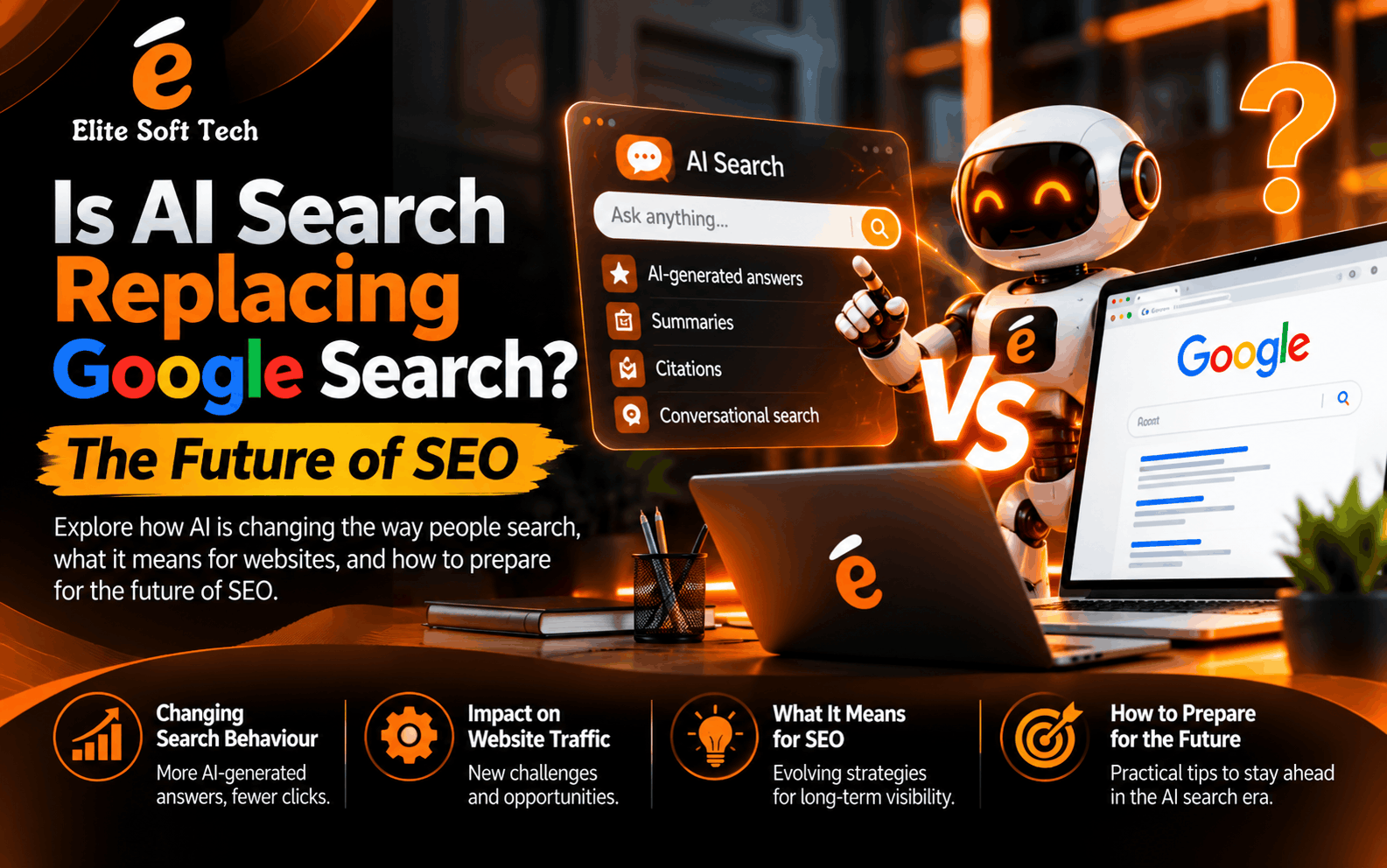
For more than two decades, “just Google it” was the default answer to almost every question. Today, a growing number of people skip the search results page entirely and ask ChatGPT, Perplexity, Claude, or Gemini instead. Google itself now places AI-generated summaries at the top of many results. So the question every marketer, blogger, and business owner is asking is a fair one: is AI search replacing Google Search, and what does that mean for SEO? The short answer is that AI search is not killing Google, but it is permanently changing how people find information and how websites earn visibility. Here is what is happening, why users are making the switch, and how you can prepare. How Search Changed So Quickly Traditional search engines work like librarians pointing you to shelves. You type a keyword, the engine returns ten blue links, and you open several tabs to piece together an answer. It works, but it demands effort. AI search works more like a knowledgeable assistant. You ask a full question in plain language, and the system reads multiple sources, combines them, and gives you one direct answer, often with citations and the option to ask follow-up questions. Instead of researching, you are having a conversation. This shift became mainstream because large language models became good enough to summarize, compare, and explain, and because the tools became free or cheap and easy to access from a phone. Google responded with AI Overviews and AI Mode, which shows that even the market leader believes the old format is no longer enough. Why People Are Changing Their Search Engine to AI Users are not switching because AI is trendy. They are switching because it solves real frustrations with traditional search. 1. Direct answers save time. Instead of scanning ten links, you get a clear response in seconds. For questions like “what is the difference between a Roth and traditional IRA?” or “how do I fix this error message?”, that speed is hard to beat. 2. Conversational, natural queries. You no longer need to guess the perfect keywords. You can write a long, messy, specific question and get a relevant reply. You can also follow up with “explain it simpler” or “give me an example” without starting over. 3. Less clutter. Many search result pages are crowded with ads, sponsored listings, affiliate-heavy articles, and pages written mainly to rank rather than to help. AI tools feel cleaner by comparison. 4. Personalisation and context. AI assistants remember what you said earlier in the conversation and tailor answers to your situation. A traditional search treats every query as a fresh start. 5. Help with tasks, not just information. AI can summarise a long report, compare products, plan a trip, write an email, or generate code. Search engines point you to information; AI tools help you do the work. 6. Synthesis across sources. Research that once took an hour of reading can be condensed into a structured overview, which is especially useful for students, professionals, and busy shoppers. Is AI Search Really Replacing Google? Not entirely, and not yet. It is more accurate to say that search is splitting into different behaviours. Google remains dominant for several types of searches. People still rely on it for navigation (finding a specific website), local results (restaurants and services nearby), shopping, maps, news, and quick facts. These are areas where fresh data, real-time indexes, and location signals matter, and Google has spent years building that infrastructure. AI tools are growing fastest for research, learning, brainstorming, comparisons, coding help, and complex questions that have no single page as an answer. In other words, AI is taking over the kind of searches that used to be frustrating. There are also real limitations. AI systems can produce confident but incorrect answers, which are often called hallucinations. They may struggle with very recent events unless connected to live search. And because they summarise rather than send you elsewhere, it can be difficult to verify claims unless you check the cited sources. The most realistic picture is a blended future. Many people will use both, and the line between a “search engine” and an “AI assistant” will keep blurring as Google adds more AI and AI companies add more live search. How AI Search Is Changing SEO For website owners, the biggest change is the rise of zero-click behaviour. When an AI answer satisfies the user, they have no reason to visit your page. That can reduce traffic for informational content such as simple definitions, basic how-tos, and quick comparisons. At the same time, AI answers cite and recommend sources. Being named in an AI response can be a powerful form of visibility, even if it does not always produce a click. Several shifts follow from this: The Future of SEO: What Will Matter Most SEO is not dying. It is evolving, and it is expanding into what many now call GEO (generative engine optimisation) or AEO (answer engine optimisation). The fundamentals of helping people still apply, but the tactics are shifting. Original value over generic content. Original research, first-hand experience, case studies, unique data, and expert opinion are things an AI cannot invent. These are the assets that get cited. E-E-A-T stays central. Experience, expertise, authoritativeness, and trustworthiness are the signals both Google and AI systems use to decide whom to believe. Real author bios, credentials, sources, and transparent information help. Clear, structured, answer-ready writing. Use descriptive headings, short direct answers near the top of sections, bullet lists, tables, and FAQ sections. Content that is easy for a machine to extract is more likely to be quoted. Structured data and technical health. Schema markup, fast-loading pages, clean site architecture, and crawlable content still matter, because AI systems that browse the web rely on the same foundations. Brand and off-site presence. Mentions on reputable sites, reviews, discussions on communities like Reddit and YouTube, podcasts, and press coverage all shape how AI systems perceive your brand. Think beyond your own website. Multi-format content. Video,