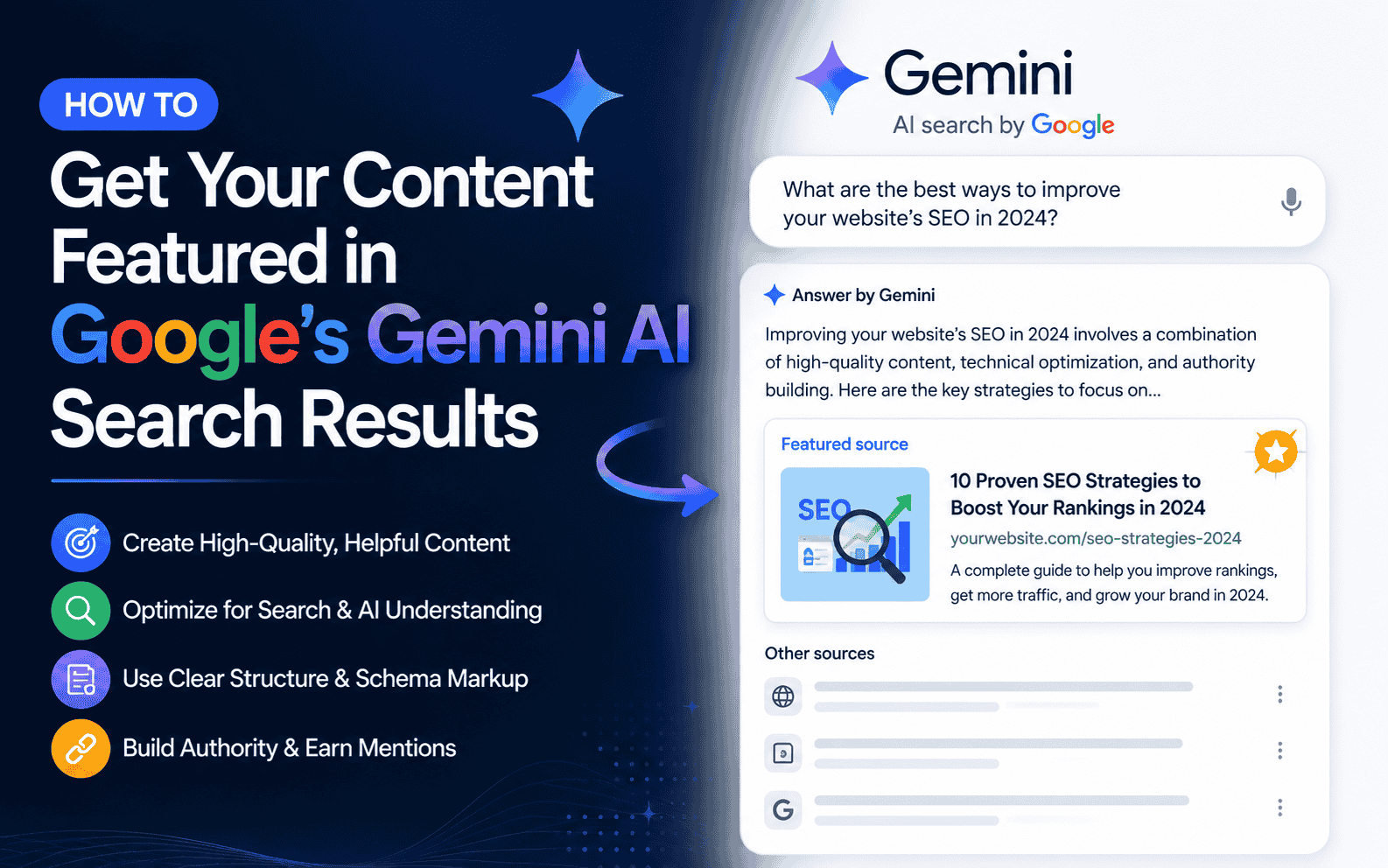
Google Search has fundamentally changed. Powered by Gemini, its AI Overviews and AI Mode now appear on nearly “48% of all queries” – pushing traditional organic results below the fold and rewriting the rules of visibility. The good news? Brands that are cited inside these AI responses see conversions up to 5x higher than regular organic clicks. This guide breaks down exactly what it takes to get your content featured – based on the latest research and Google’s own official guidance. First: Understand How Gemini Picks Its Sources Before optimizing, you need to understand the mechanism. Google’s Gemini-powered features use two core techniques: – RAG (Retrieval-Augmented Generation): Gemini doesn’t generate answers from memory alone. It retrieves fresh, relevant pages from Google’s Search index in real time, then synthesizes a response – citing the sources it used. – Query Fan-Out: When you type a query, Gemini silently fires off a cluster of related sub-queries. For example, “best running shoes for flat feet” might fan out into “best cushioned running shoes,” “orthopaedic running shoes 2026,” and “how to choose shoes for overpronation.” Your content is only retrieved if it aligns with one or more of these fan-out variations – not just the original query. The implication: You’re not just optimizing for a keyword. You’re optimizing to be retrieved across a cluster of related intents. 1. Create Non-Commodity Content with a Unique Point of View This is Google’s single biggest piece of advice – and the research backs it up. Commodity content (“7 Tips for First-Time Homebuyers”) can be produced by anyone or any AI model. It adds little unique insight, and Gemini has plenty of sources to choose from instead of you. Non-commodity content (“Why We Waived the Inspection & Saved Money: A Look Inside the Sewer Line”) brings a unique expert or first-hand perspective that goes beyond common knowledge. Practical tips: Write from direct experience. First-hand reviews, case studies, and original data outperform aggregated summaries.– Include original statistics or research. Content featuring original data sees 30–40% higher visibility in AI responses.– Take a clear stance. Gemini is looking for authoritative perspectives, not neutral recaps.– Ask yourself: “Could a generative AI have written this without knowing what I know?” If yes, rewrite it. 2. Build Strong E-E-A-T Signals E-E-A-T – Experience, Expertise, Authoritativeness, Trustworthiness – is weighted more heavily in Gemini citations than in almost any other ranking context, because Google controls both the quality rating framework and the AI model that consumes it. How to demonstrate E-E-A-T: – Include clear author bios with credentials and relevant experience.– Link to authoritative external sources to support your claims.– Earn coverage and citations in established third-party publications. Research suggests 82–89% of AI citations come from third-party publications, not brand-owned content alone.– Keep content fresh. AI platforms cite content that is on average 25.7% fresher than traditional organic results. 3. Structure Your Content for Machine Extraction Gemini doesn’t just read your page – it scans it for extractable, quotable answers. LLMs are 28–40% more likely to cite content with clear formatting. Structure matters enormously. Best practices: – Use a clear heading hierarchy (H1 → H2 → H3). Each section should answer a distinct question.– Lead with a direct answer at the top of each section before expanding. Think of it as a TL;DR for every heading.– Use FAQ-style sections for question-based queries. FAQPage schema markup significantly boosts eligibility.– Write in short, scannable paragraphs – 2 to 4 sentences each.– Use numbered lists and bullet points for steps and comparisons.– Avoid burying your key insights deep in long blocks of prose. 4. Use Structured Data (But Don’t Overcomplicate It) There is no special Gemini-specific schema. Google has confirmed this. The structured data you implement for regular SEO is exactly what Gemini reads – with AI citation visibility as a downstream benefit. That said, the correlation between structured data and AI citation rates is significant. Third-party research suggests pages with structured data may see a +73% selection boost, with pages combining multimodal content and structured data seeing even higher lifts. Prioritise these schema types: – `FAQPage` – critical for question-answer content– `Article` / `BlogPosting` – establishes content type and authorship– `Organization` – builds entity authority– `HowTo` – strong for instructional content– `Product` / `Review` – for ecommerce and review content 5. Build Topical Authority, Not Just Individual Pages Gemini favours sources that demonstrate comprehensive topical coverage – not just a single well-ranked page. When the AI evaluates sources to cite, it favours sites that have addressed the full scope of a topic. How to build topical authority: – Develop content clusters: a pillar page covering the broad topic, supported by detailed articles on each subtopic.– Interlink all cluster pages with contextually relevant anchor text.– Cover semantic neighbours: if your topic is “AI SEO,” related pages should cover E-E-A-T, structured data, semantic SEO, AI Overviews, and so on.– Avoid leaving significant subtopics unaddressed – topical gaps reduce your cluster’s authority signal. 6. Go Beyond Your Website: Build Cross-Platform Presence One of the most surprising findings from 2026 research: 88% of Google AI Mode citations come from pages outside the organic SERP for the same query. Ranking on Google alone does not guarantee you appear in Gemini. Gemini also draws from high-authority third-party domains. As of early 2026, the most-cited domains across AI platforms include Reddit, LinkedIn, YouTube, Wikipedia, and Forbes. What this means for you: – Pursue earned media in publications Gemini trusts – industry blogs, news sites, trade publications.– Build a presence on LinkedIn – it rose to #1 for professional queries, with citation frequency doubling between late 2025 and early 2026.– Optimise your YouTube content – video is increasingly surfaced in Gemini responses.– Encourage genuine community discussion on Reddit and niche forums.– Aim for consistent entity corroboration: your brand/product/name should appear with the same factual signals across multiple independent sources. 7. Meet the Technical Fundamentals No amount of great content helps if Gemini can’t access or index your pages.– Ensure crawlability: Gemini uses publicly accessible,